
- August 24, 2026
- Posted by: admin
- Categories: Black Feminist Archive, Black Feminist Speaker Archive, Womanist Archive
Updated
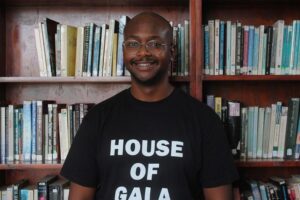
Bonke Sonjani is currently pursuing an MA in Heritage Studies at the University of the Witwatersrand. He is also an archivist intern at the GALA Queer Archives where he is interested in queering student protests in South Africa.
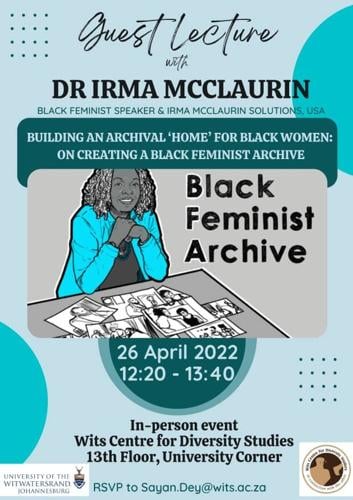
Dr Irma McClaurin recently presented a guest lecture with the University of the Witwatersrand Centre for Diversity Studies in which she talked about her renowned Black Feminist Archive established for the conservation and dissemination of black women’s history and heritage. The Black Feminist Archive is one of a kind– it is the first archive in the world that acts as a catalyst for the collection, protection and dissemination of the voices of Black African/American women that have been inherently ostracized from official histories. Dr McClaurin initially developed the archive as a memory of her own life and lived experiences in the various institutions she has worked for. In recognizing the power relations embedded in the cis-gender, male-dominant field of study- Anthropology in which she has obtained a PhD at the University of Massachusetts Amherst, McClaurin acts as a vector for both resistance and radical re-imagination. The Black Feminist Archive provides a training ground for Black women archivists to counter the heteropatriarchal profession of archiving.
McClaurin says she believes that everyone is an archive filled with a rich family and professional and social history. According to her, “Our stories are a necessary (and sometimes secret) ingredient in a recipe of impactful social change in America” ( McClaurin 2021). As such, she encouraged everyone in the lecture to start documenting their emails, letters, notes and lived experiences, positing that these serve as archives of thoughts, methodologies and events. McClaurin’s positionality on the Black Feminist Archive is inspirational. She does not approach the project from the ‘institutionalized’ practice of archiving which has a discursive history of eradicating queer, Black and women’s bodies from the recognized narratives of history. Moreover, through what I would coin as a ‘bottom-up’ methodology, McClaurin lifts Black women—to celebrate and preserve their experiences and narratives that reflect “whole lives” of activism, resistance, creativity, and intellectual production. Through such methodologies, their lives and diverse forms of input (artistic, social, political, scientific, etc.) are recognized as having played a major role in the development of a fuller American story (McClaurin 2021).
McClaurin’s artistic practices both as an activist bio-cultural anthropologist and as an archivist are inspiring to me as a young scholar. As a previous recipient of the Andrew W Mellon award under the History department with the Centre for Humanities Research at the University of the Western Cape, and as an aspiring curator, archivist and heritage practitioner, McClaurin’s work has provided a blueprint for my artistic practices. As a previous history scholar from a historically Black university that does not have an art school, McClaurin has inspired my positionality within my artistic research interests.
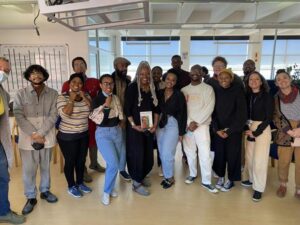 What sets McClaurin apart from other scholars and artists is her aura– during the lecture, one could not help but feel so empowered and inspired to start the projects that they have been postponing. This was the same case for me as well, I have been struggling to locate myself within my research interests. I have been consulting my lecturers and various other people who could potentially inform my curatorial practices on the ‘how to’ curate and initiate the projects I have conceived in mind. McClaurin’s sense of assertion on the Black Feminist Archive has thus inspired me beyond these various engagements I have had with other scholars and artists. I have learnt that following the institutionalized ‘how to’ curate cannons only reiterates the gendered, heteropatriarchal terrains of artistic practices. And so countering these cannons as McClaurin has would provide what Alberta Whittle coins “ a way-ward strategy of curating” in which she asserts that ‘biting the hand that feeds you’ (referring to official institutions) is necessary to the destruction and harmful patterns of contemporary arts (Whittle 2019).
This notion of ‘biting the hand the hand feeds you’ as posited by Whittle involves engaging with communities and ordinary citizens in order to infiltrate and counter the cis-gender, white spaces in contemporary arts. McClaurin has in practice utilized this way-ward strategy of curating the Black Feminist Archive by preserving the material of Black women like miss Archie Henderson Jones, who will be 97 years old this year. According to McClaurin, miss Archie is an anthropologist whose work remains unpublished on academic journals and websites such as google scholar, academia and JSTOR because of her defiant approach to anthropology which deemed Black people as not worthy of research.
By engaging with her material, the Black Feminist Archive aims to bring to the fore her material on Black people whilst giving her agency and recognition at the same time. As a feminist scholar interested in recovering the ostracized narratives of queer folk from student protests such as the Fees Must Fall and Rhodes Must Fall Movements, I have been inspired by the Black Feminist Archive to ‘bite the hand’ by demonstrating agency for the queer student community through writing an arts-based research project that illustrates the contribution of queer folk on the movements.
Reference list
Whittle, A. 2019. Biting the Hand That Feeds You: A Strategy of Wayward Curating, Critical Arts, 33;6, 110-123
McClaurin, I. 2021. Black Women: Visible and Heard. Founding the Black Feminist Archive at UMass. The University of Massachusetts Amherst.